The Origins: Traditional Japanese Tattooing (Irezumi)
Irezumi, traditional Japanese tattooing, goes back to the Edo period (1603–1868). It developed as a full-body art form with specific social weight: first used as criminal marking, then adopted by craftsmen and eventually by the Yakuza as a symbol of brotherhood and commitment.
Classical Irezumi follows strict formal rules:
- Flatback compositions: designs that wrap naturally around the body, treating the torso and limbs as one continuous canvas
- Restricted palette: primarily black, red, and blue-green (indigo)
- Codified motifs: each subject carries specific symbolic weight, used according to tradition
- Background treatment: wind bars, clouds, and waves fill negative space to unify the composition
The tradition was kept by a small number of master tattooers called Horishi. They worked with hand-poked tebori needles and taught through apprenticeship, not schools.
What Makes Neo-Japanese Different
Neo-Japanese tattooing works from the visual grammar of Irezumi without treating every technical convention as fixed. Contemporary artists can use dimensional shading, a wider color range and narrative subjects that extend beyond the small group of motifs most often reproduced outside Japan.
| Dimension | Traditional Irezumi | Neo-Japanese |
|---|---|---|
| Composition | Full-body flatback wrap, strict spatial rules | Flexible: standalone pieces or full-body, dynamic layouts |
| Color palette | Black, red, indigo: limited and codified | Full spectrum: vivid, contemporary, varied |
| Shading | Flat to gradient, traditional ink gradation | Three-dimensional, cinematic depth, complex tonal range |
| Motifs | Classic motifs only, precise symbolic usage | Classical subjects plus broader folklore, interpreted freely |
| Technique | Often tebori (hand-poked) or traditional machine | Modern machine technique with precise needle control |
| Rules | Strict formal discipline | Informed by tradition, freed by contemporary expression |
The tension in neo-Japanese is real: the more you break from Irezumi's rules, the more you risk losing what made the imagery powerful in the first place. The best artists know the rules well enough to break them on purpose.
Beyond the Usual Motifs: Yōkai and the Night Parade
Koi, dragons, tigers and Hannya masks remain valid references, but they are only the most familiar edge of Japanese visual culture. For Nima, yōkai folklore is more interesting: its beings have names, strange rules, local histories, humor, danger and contradictions. That specificity gives a tattoo a real narrative instead of a generic symbolic label.
The Hyakki Yagyō, or Night Parade of One Hundred Demons, gathers yōkai, oni, ghosts, animated objects and other supernatural beings into a nighttime procession. It is especially useful for tattoo composition: a sleeve or backpiece can become one moving scene rather than a stack of unrelated motifs.
Reference: Yokai.com, Matthew Meyer's illustrated database of Japanese ghosts and monsters.
- Tenome — an eyeless figure whose eyes appear in its palms.
- Wa nyūdō — a fearsome head trapped in a flaming ox-cart wheel.
- Ungaikyō — a haunted mirror that reveals and manipulates monstrous reflections.
- Karakasa kozō — a transformed paper umbrella, mischievous rather than purely terrifying.
- Ippondatara — a one-legged, one-eyed mountain yōkai tied to blacksmith lore.
- Suzuri no tamashii — an old inkstone animated by the story repeatedly copied upon it.
Current Neo-Japanese Tattoo Work
These photographs show Nima's current linework, color, scale and body-flow composition. The captions describe what is actually tattooed; the images are not presented as yōkai pieces when they depict other subjects.
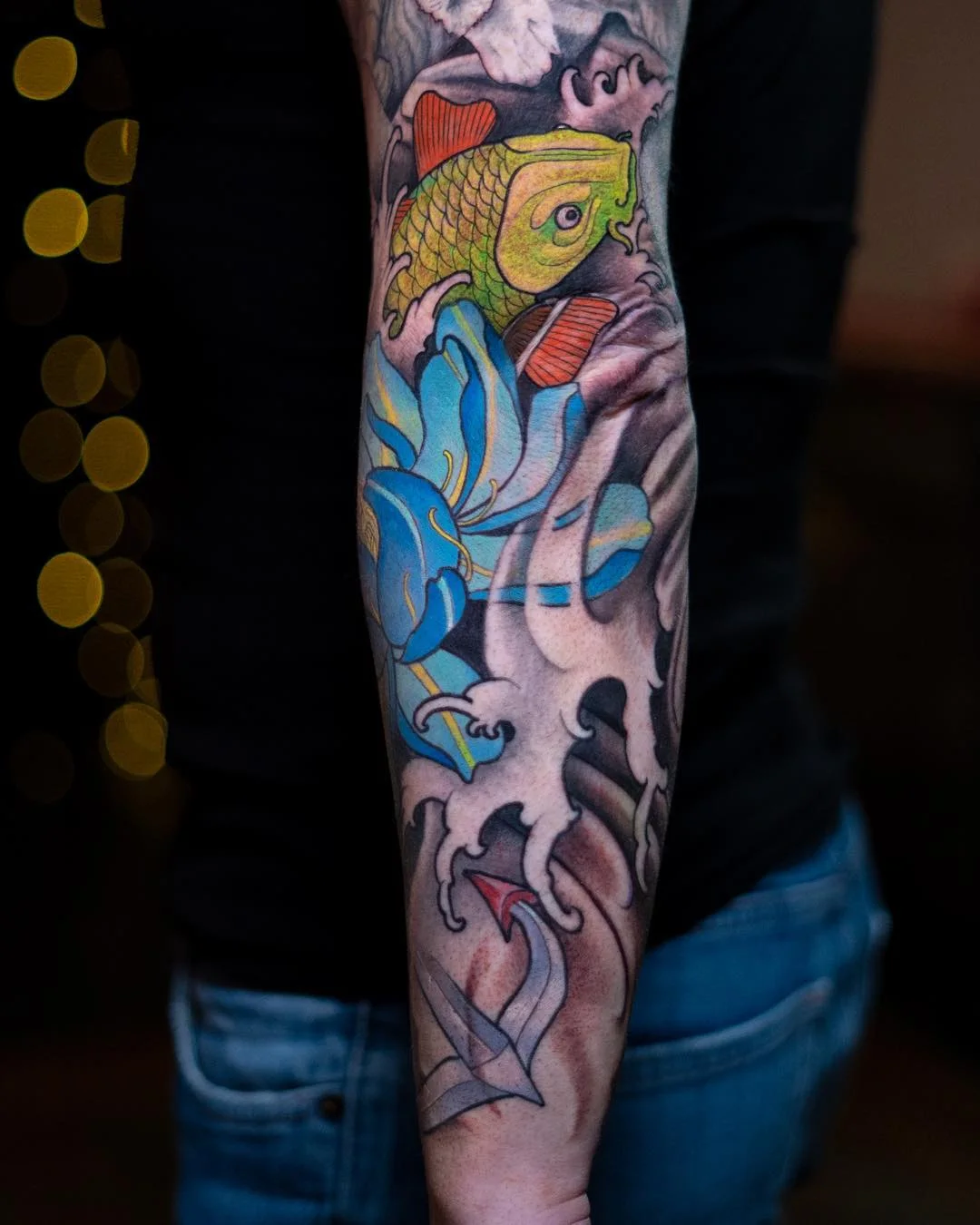
Koi and Blue Flower
Neo-Japanese forearm composition.
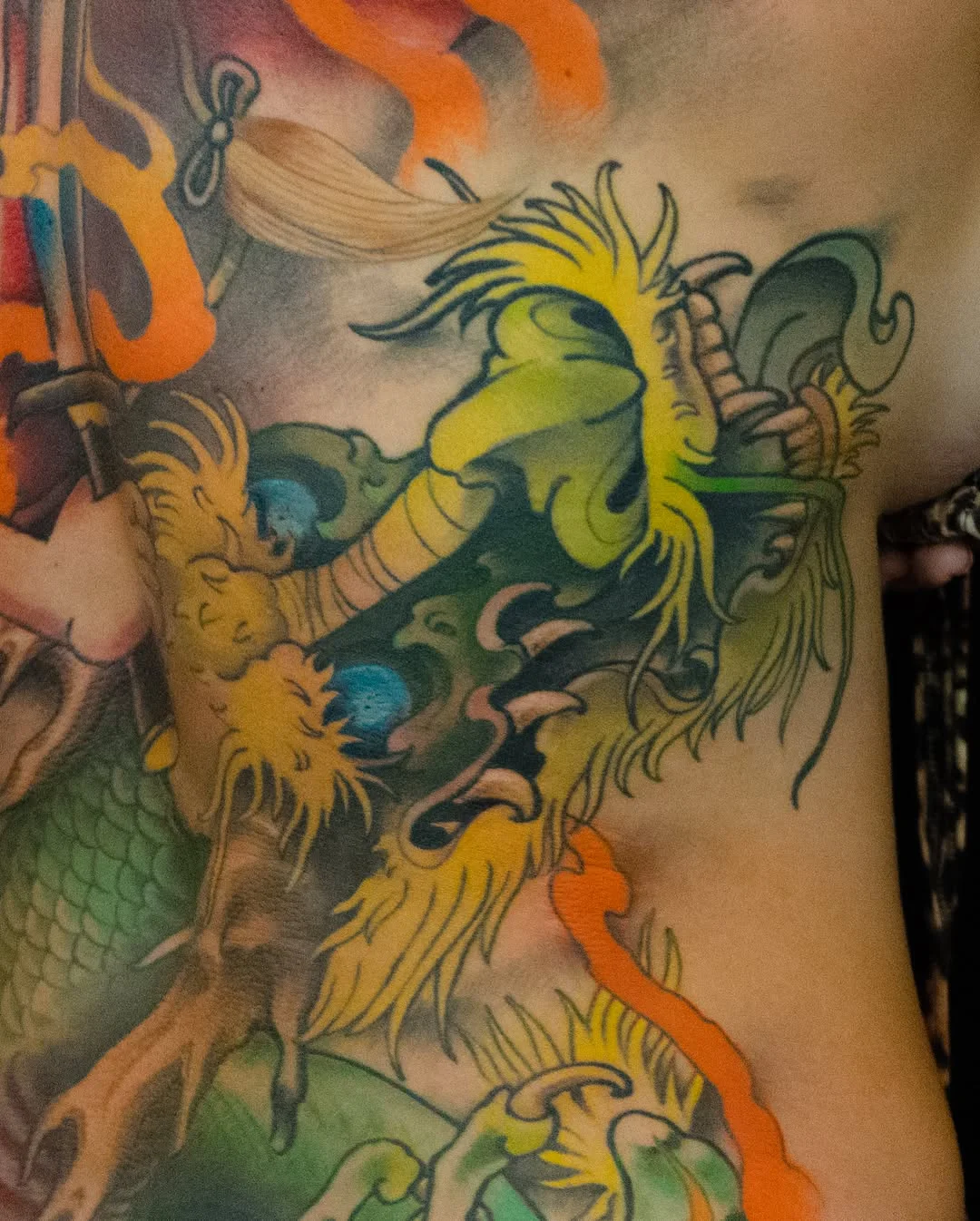
Dragon Backpiece Detail
Close view of a large-scale back composition.
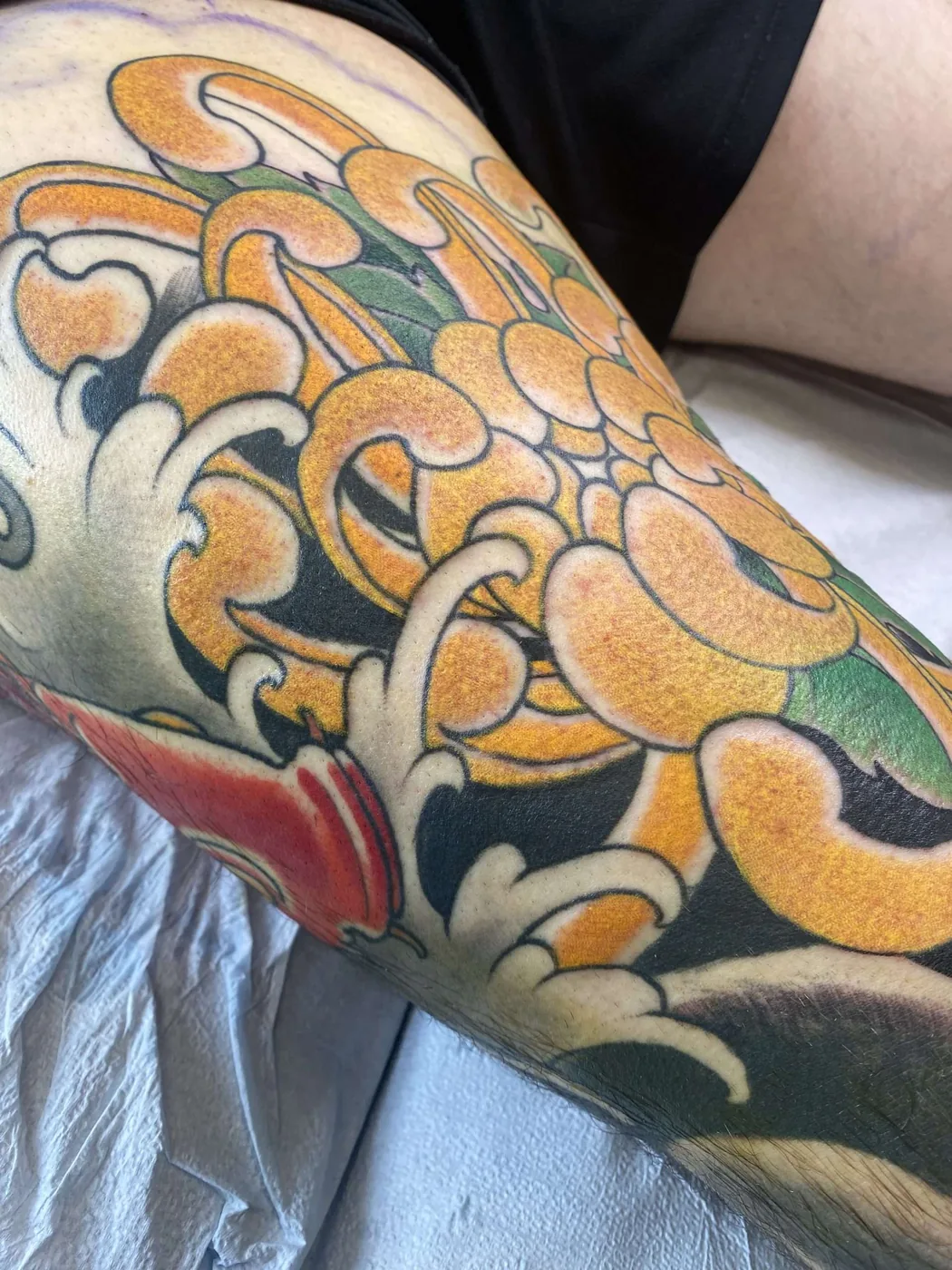
Chrysanthemum
Color thigh tattoo with Japanese floral structure.
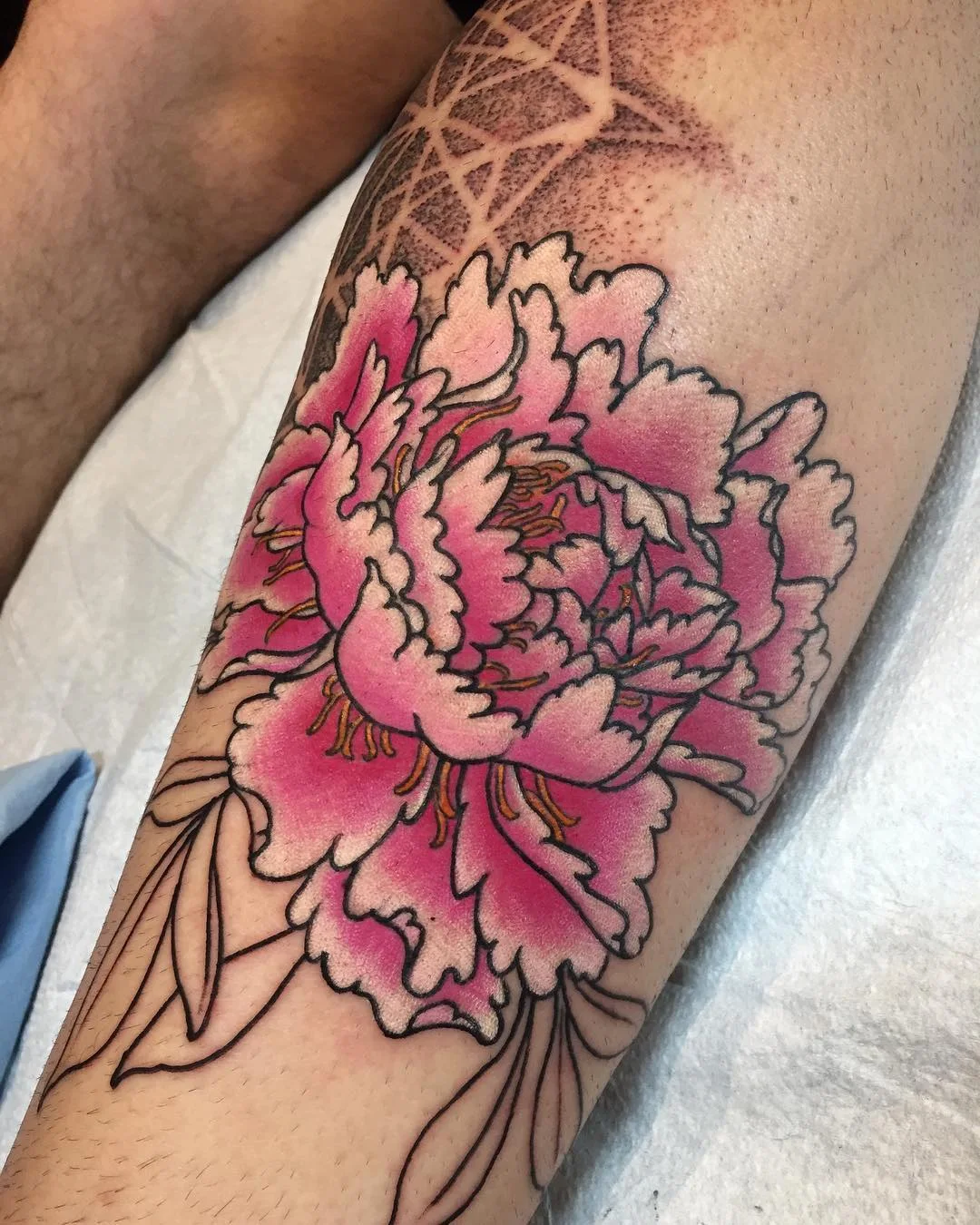
Pink Peony
Japanese flower tattoo with a geometric dotwork background.
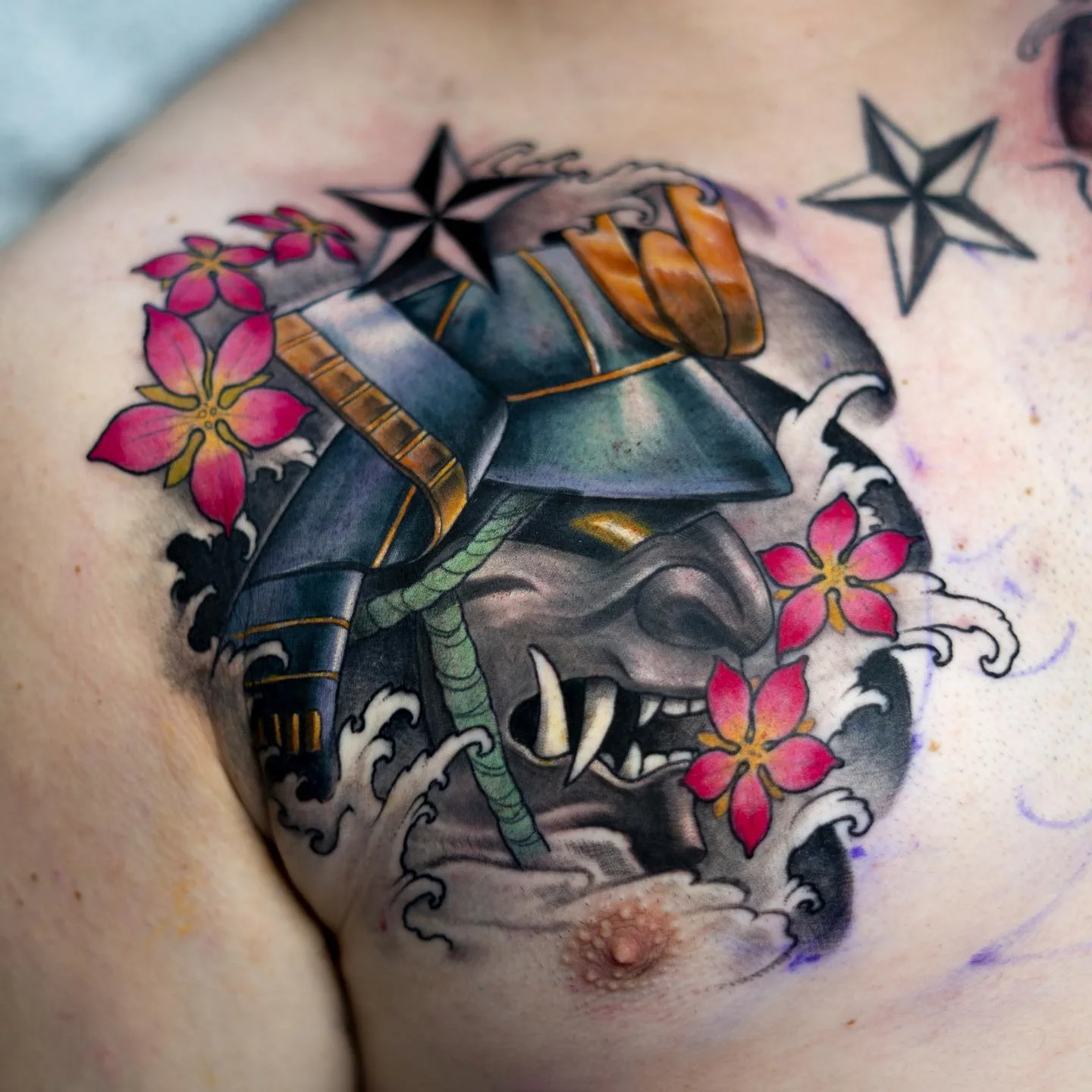
Samurai Mask
Chest piece with waves and cherry blossoms.
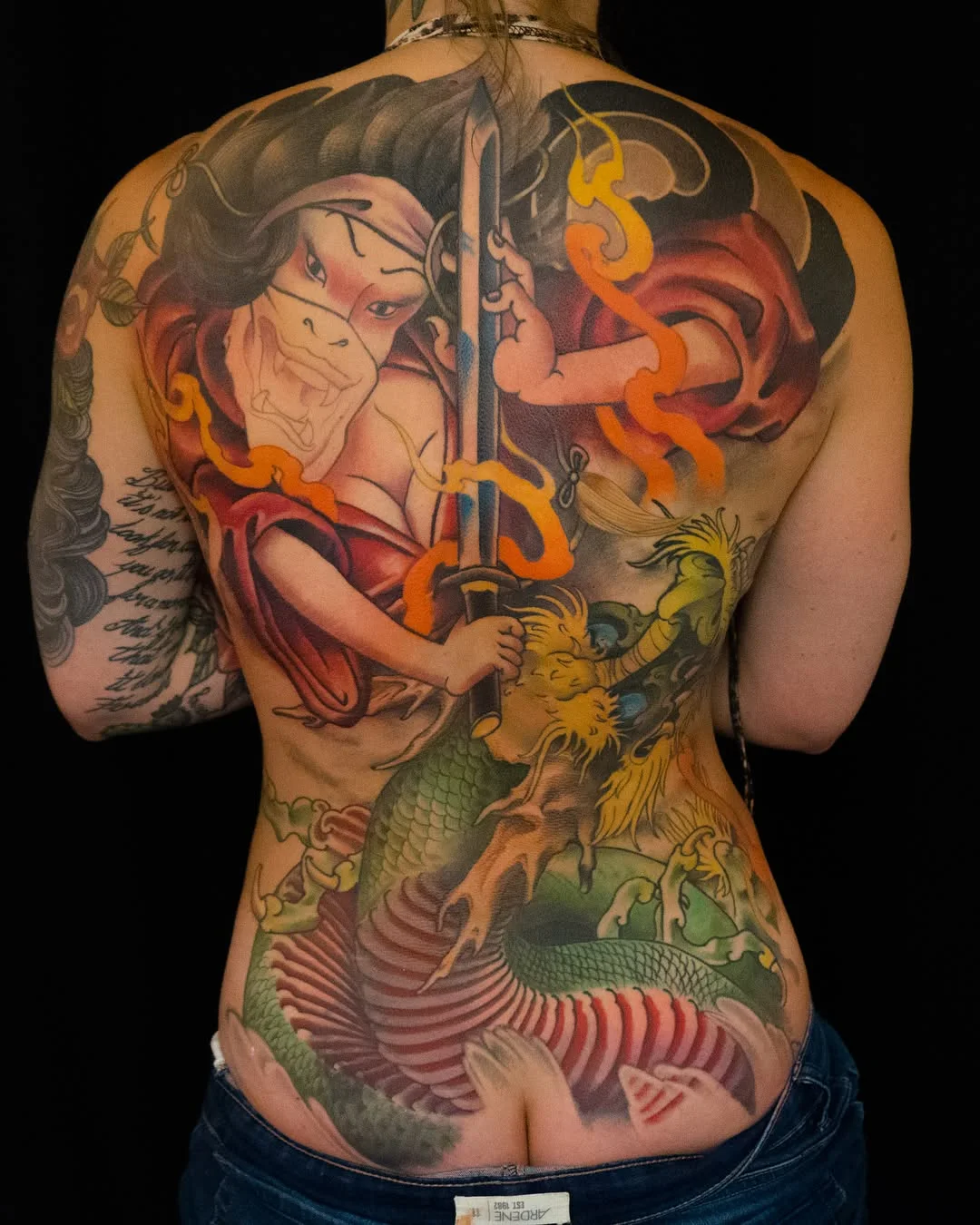
Samurai and Dragon
Full backpiece composed as one continuous scene.
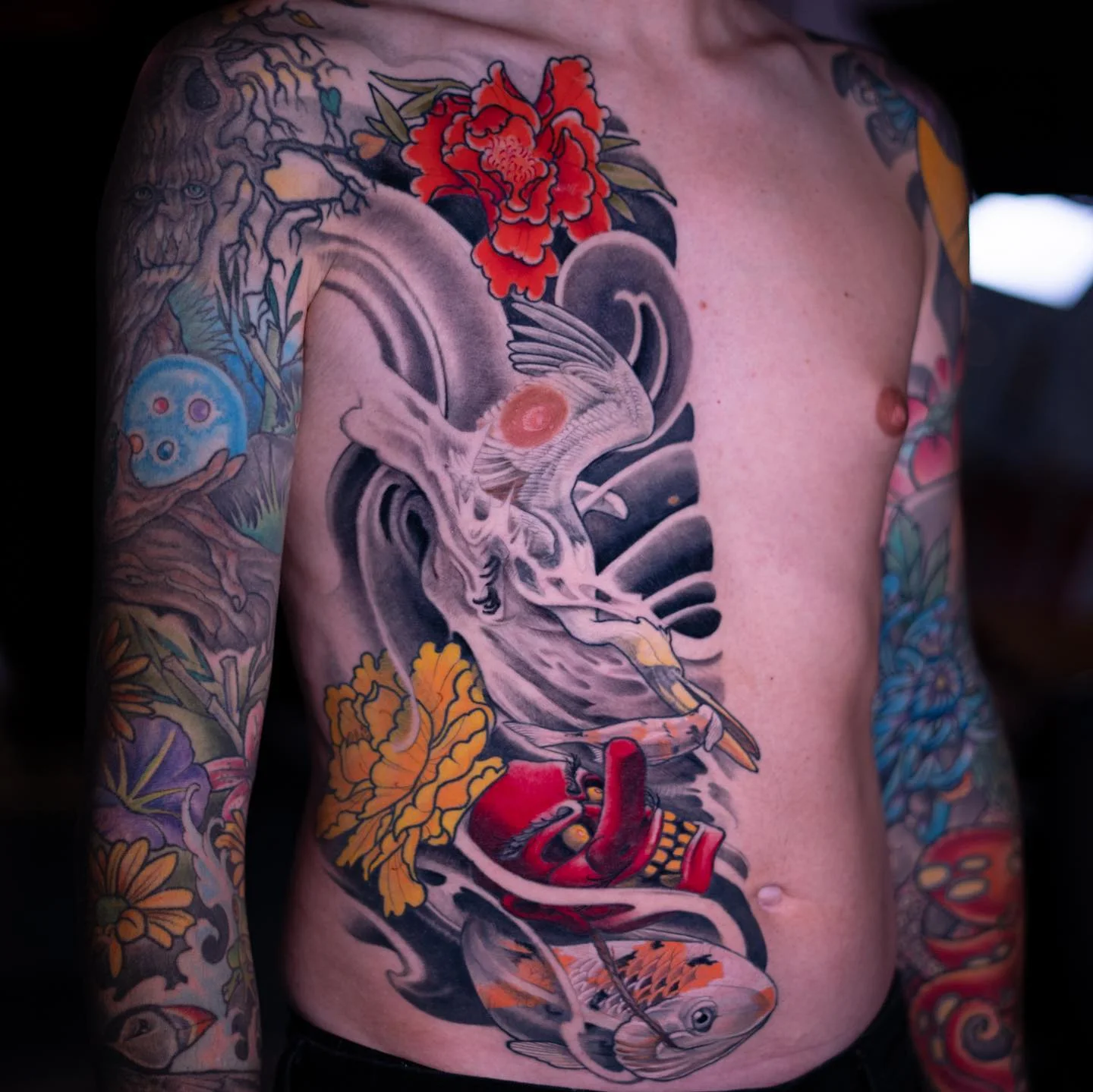
Crane, Skull and Koi
Layered chest composition with floral elements.
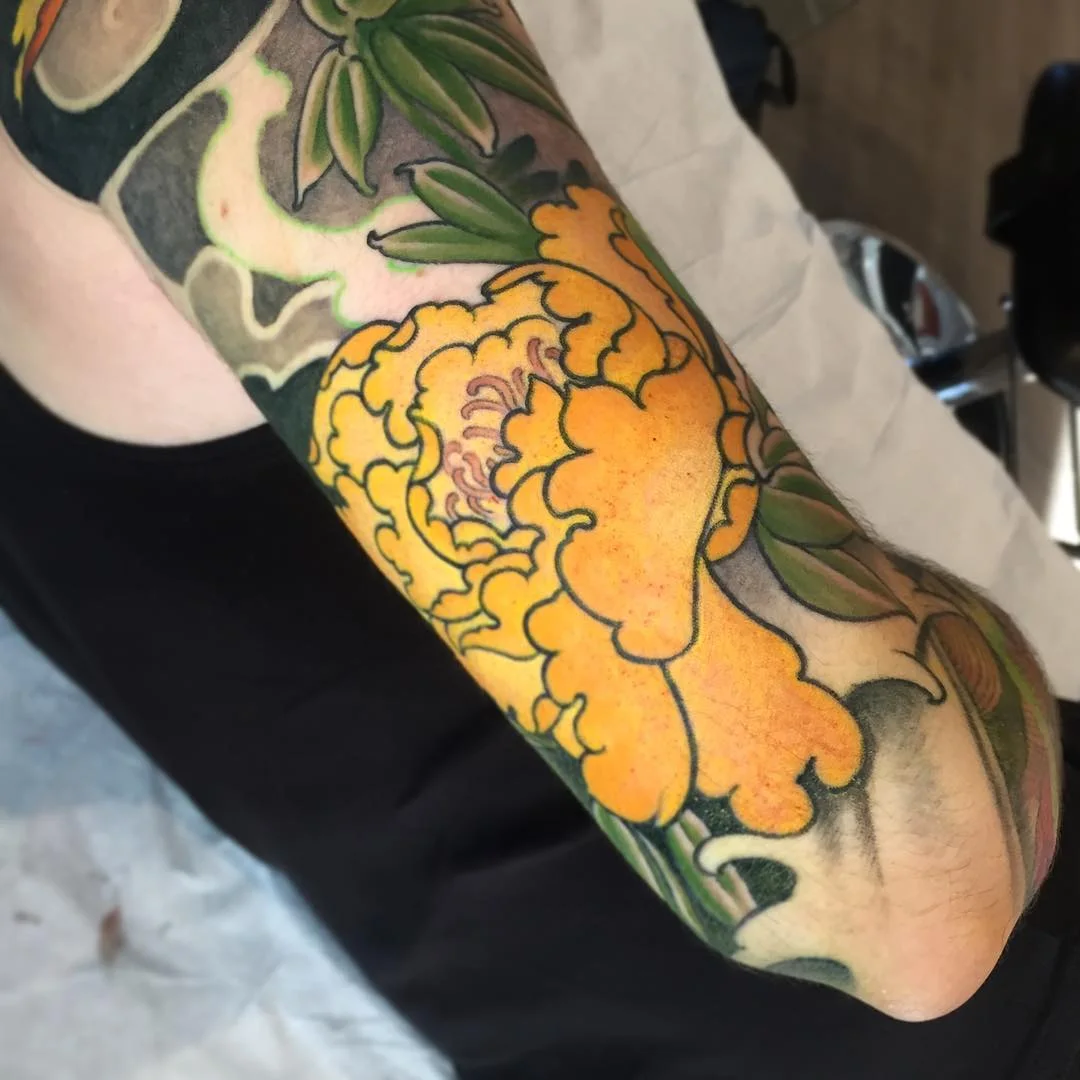
Yellow Peony Sleeve
Large floral element integrated into an arm composition.
What Defines Outstanding Neo-Japanese Work
Neo-Japanese is technically demanding in ways that don't always show up in reference photos. A few things separate the work that holds up from the work that doesn't:
Dimensional shading
Classical Japanese tattooing uses relatively flat fill with gradation at edges. Neo-Japanese introduces three-dimensional shading — the same tonal complexity used in black and grey realism, applied to Japanese subject matter. A dragon's scales should have depth, not just color. A chrysanthemum should feel three-dimensional, not printed.
Compositional intelligence
Strong neo-Japanese compositions understand negative space and how the design moves with the body. A sleeve isn't a collection of motifs stacked on top of each other. It's a unified composition where each element relates to the others through scale, flow, and rhythm.
Controlled linework
Japanese-influenced tattooing relies on confident, clean linework to define forms. Inconsistent or scratchy lines undermine the entire piece, even when the shading and color are otherwise strong.
Neo-Japanese is Nima Jolan's signature style. His work sits at the intersection of Irezumi's visual grammar and modern tattooing technique. Every piece is designed from scratch, built for the specific placement and the person wearing it. See the dedicated service page for Neo-Japanese tattoo Montreal, then use the full-day session preparation guide before a long appointment.
FAQ
What is neo-Japanese tattooing?
Neo-Japanese tattooing applies contemporary shading, color and composition to the visual language of Japanese tattooing. It can work with yōkai folklore and complete narrative scenes as well as familiar Japanese tattoo subjects.
What is the difference between neo-Japanese and traditional Japanese (Irezumi) tattoos?
Traditional Japanese tattooing follows established compositional conventions, palettes and relationships between subjects and backgrounds. Neo-Japanese artists work from that visual grammar while using contemporary shading, broader color choices and freer narrative compositions.
What is the Hyakki Yagyō?
Hyakki Yagyō translates as the Night Parade of One Hundred Demons. It is a Japanese folklore scene in which yōkai, oni, ghosts, animated objects and other supernatural beings move together in a nighttime procession.
Why are yōkai useful subjects for neo-Japanese tattoos?
Yōkai have distinct personalities, behaviors, local histories, humor and danger. That specificity gives an artist more narrative material than a generic symbol and makes it possible to build a complete scene around the client's body.
How many sessions does a neo-Japanese sleeve take?
A full sleeve typically requires 4 to 8 full-day sessions. A half-sleeve can often be done in 2 to 4 sessions. At Nima Tattoo, each session is a full day — 4 to 6 hours of effective tattooing.